How Your Business Credit Score Affects Loan Approval Odds


.png)
Summary: This guide explains how UK lenders read business credit scores, how those scores affect approval odds, limits, and pricing, and what you can do to improve your position before you apply.
What your business credit score actually measures
Your business credit score is a forecast of risk. It predicts the chance that your company will pay on time over the next 12 months. Lenders use it to make quick, consistent decisions. It gives them a standard view across many firms, sectors, and sizes.
In the UK, several credit reporting agencies hold data on your company. The main ones are Experian, Equifax, Dun and Bradstreet, and Creditsafe. Each agency uses its own scoring model and range. Some use 0 to 100, others use wider scales. Higher means lower risk. A score in the top band signals strong payment behaviour, low levels of court action, and clean filings with Companies House.
Scores sit on top of raw data. That data includes trade payment records, director links, accounts, CCJs, and credit utilisation. The score changes when the data changes. Late payments, a new CCJ, or rising debt will drag the score down. On time payments, low utilisation, and prompt filings support a higher score.
Score to decision flow
How lenders use your score to decide yes, no, and how much
Think of the score as the entry point to five decisions a lender must make:
- Approve or decline the application.
- Set the credit limit or loan size.
- Price the loan, which means the interest rate and fees.
- Decide what security to ask for, such as a personal guarantee or a fixed charge.
- Set covenants, such as minimum net worth or maximum leverage.
Lenders group scores into bands. Each band links to typical approval odds and pricing. The exact cut offs vary by lender, product, and sector. As a guide:
- Excellent band: high approval odds, larger limits, lowest rates, lighter security.
- Good band: solid odds, fair limits, competitive rates, security likely on larger deals.
- Fair band: mixed odds, smaller limits, higher rates, security common.
- Poor band: low odds with mainstream banks, specialist lenders may still help at a cost.
Two firms can share the same score and get different results. Sector risk, years trading, profit trends, and existing debt also matter. The score opens the door. The rest of the file sets the terms.
Score bands vs typical APRs
How to check your company credit in the UK, step by step
Before you apply for finance, check your business credit score with our in-house tool. It is built by our brokers and devs, and it helps you see if your business is ready for a loan. You get a clear score band, the key risk flags that lenders look at, and simple next steps you can act on today.
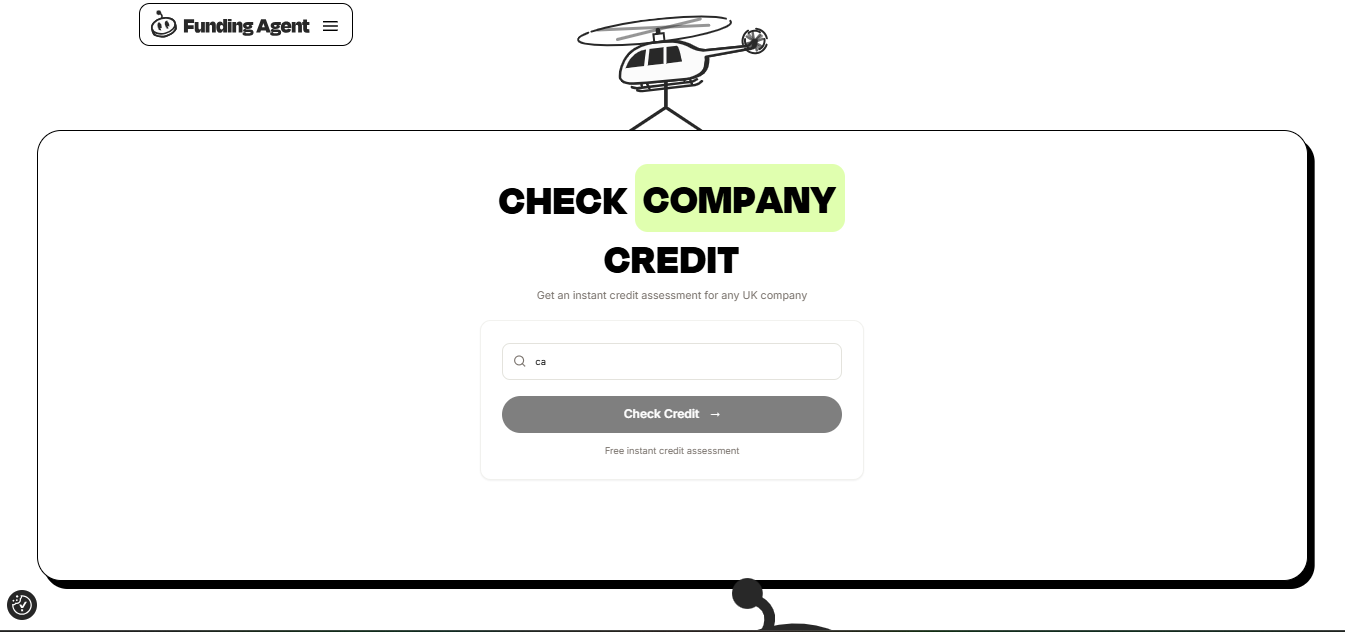
Check your business credit score easily with a tool built by our brokers and devs to help you understand if your business is ready for a loan.
- Open the checker: Enter your company name or Companies House number, then confirm your firm.
- Review your snapshot: See your score band, recent payment behaviour, any CCJs on file, filing status, and a quick view of credit utilisation.
- Read your readiness rating: Get a simple traffic light view, ready, borderline, or not ready, with reasons.
- Download or email the summary: Save a copy for your records, then share it with your team if needed.
- Follow the action plan: Fix easy items first, errors in data, overdue accounts, high utilisation, then plan medium term steps.
If you want a deeper dive, you can still order full bureau reports from Experian, Equifax, Dun and Bradstreet, or Creditsafe. For most loan decisions, the checker gives enough detail to gauge your odds and target the right product first.
UK credit check steps
What a business credit report includes, and how to read it
A standard report gives a clear view of your financial health. Expect to see these items:
- Credit score and risk rating: A number and a band that sum up risk at a glance.
- Payment history: Days beyond terms, percentage paid within terms, and trends over time.
- Public records: CCJs, insolvencies, or bankruptcies, with dates and amounts. To check or satisfy a CCJ, use TrustOnline.
- Financial filings: Turnover, profit, net assets, and ratios from your Companies House accounts. File on time via Companies House.
- Credit utilisation: Outstanding balances versus limits on credit lines and cards. Consider revolving credit planning to keep utilisation in check.
- Director and group links: Associated companies and shared officers. If you need to correct data, read your rights at the ICO.
Read the report with a lender’s eye. Ask, what risk does this file suggest over the next year. Focus on three red flags first. A new or unpaid CCJ, frequent late payments, and high utilisation. Fix these, your score will often follow. For jargon, see our finance dictionary.
Personal credit checks for directors, when they matter
Small or young businesses have thin files. Many lenders will review the director’s personal credit in these cases. They may ask for a personal guarantee on unsecured loans or overdrafts. A strong personal file can offset a short trading history. A weak personal file can limit options or raise the price. Plan for this if you have fewer than two years of filed accounts, or if your turnover is modest.
Finance types and the score they expect
Different products carry different risk for the lender. That shapes the score they expect and the price they set.
- Term loans: Medium to long terms, often need solid scores. Banks prefer strong files, specialist lenders may accept fair scores with security or higher rates.
- Revolving credit and overdrafts: Expect higher score demands due to flexibility. Pricing moves fast with the band.
- Asset finance, hire purchase, and leasing: The asset adds security. Lenders can accept fair scores if cash flow is stable and the asset holds value.
- Invoice finance: The debtor book reduces risk. Lenders care about your customers’ quality as well as your score. Useful if you have a weaker file but strong invoices.
- Merchant cash advances: Tied to card takings. Scores matter, but turnover stability and sector also weigh in. Cost can be higher.
- Start Up Loans and grants: Suit young firms with thin credit. Personal checks apply, along with business plans and forecasts.
Match the product to your score and your cash flow. You will waste fewer applications and protect your file from too many hard searches.
Self-assessment, a 5-minute approval readiness check
Use this quick checklist to gauge your odds before you apply. If you can tick most items, you stand a better chance of a quick yes and a fair price.
5-minute readiness checklist
- Your business credit score is in the good band or better at at least one CRA.
- No new CCJs in the last 12 months, and any older CCJs are satisfied and marked as such.
- Payment terms are met with most suppliers, and days beyond terms are falling.
- Accounts are filed on time at Companies House, and the latest set shows stable or rising profit.
- Credit utilisation sits below 30 to 50 percent on revolving lines.
- You can evidence cash flow to cover repayments with a buffer.
- You have a clear use of funds and a simple payback story.
- You know which product best fits your use case.
Improve your score in 30, 60, and 90 days
Scores move when data moves. Plan fixes you can control, and stage them over the next quarter.
30, 60, 90-day plan
Days 0 to 30, fast wins
- Pull your reports from one or two CRAs. Save copies and set alerts.
- Dispute clear errors, such as wrong addresses, old director links, or misreported CCJs.
- Bring any small overdue balances up to date.
- Reduce utilisation on credit cards and overdrafts. A small repayment can lift the band.
- File any overdue accounts with Companies House.
- Ask key suppliers to report positive payment data if they do not already.
Days 31 to 60, structural steps
- Renegotiate terms with suppliers to avoid late markers while cash flow is tight.
- Consolidate small, costly lines into one structured facility if it cuts utilisation and cost. See our business loan refinancing guide.
- Set payment runs and reminders so bills land on time. Automate where you can.
- Build a basic cash flow forecast for the next six months. Share it with your lender if asked.
Days 61 to 90, signal strength
- Grow trade lines with reliable suppliers. A broader base of positive data lifts resilience.
- If you settled a CCJ, ensure the record shows as satisfied. Ask the CRA to refresh the file.
- Update Companies House with any positive changes, such as new capital or stronger assets.
- Prepare a short funding pack. Include management accounts, a cash flow, and a use of funds note.
If your score is poor, smart funding paths that still work
A poor score does not end your options. It changes them. Focus on products where the risk is shared or secured.
- Secured lending: Use property, vehicles, or equipment as security. Expect tighter LTVs and higher rates, yet approvals can be realistic. Read our take on secured vs unsecured business loans.
- Asset finance and leasing: The asset supports the deal. Lenders can accept weaker files if the asset is strong and the business can service the payments. Learn more about asset finance.
- Invoice finance: Leverage strong customers. If your debtors are good payers, the lender has comfort even if your score is modest. See our guide to invoice finance.
- Revenue based finance: Repay as a share of sales. Works for firms with steady card or online takings. Cost is higher, but access is faster.
- Guarantor backed facilities: A director guarantee can bridge a thin file. Use with care, and set clear limits. If you need options today, see our bad credit business loan page.
Be selective, and avoid credit shopping. Many hard searches in a short time can hurt your file and spook lenders. Shortlist two or three lenders that fit your profile. Apply in sequence, not all at once.
Practical example, mapping score to loan outcomes
Here is a simple, illustrative view. It does not replace a lender’s policy, yet it helps set expectations.
- Excellent band: £100k to £500k term loan possible, prime pricing, limited security, approval odds high if profit and cash flow align.
- Good band: £50k to £250k, competitive pricing, security likely above a set limit, approval odds good with clean recent history.
- Fair band: £25k to £100k with specialists, higher pricing, security and guarantees common, proof of cash flow required.
- Poor band: Under £50k with security or invoice finance, pricing wide, focus on short terms and assets that hold value.
Use this to plan your ask. If you sit in a fair band, do not lead with a prime bank request for £500k. Choose products that fit, and your odds improve.
If you are unsure which route fits, compare unsecured business loans and secured options, then size a term loan or a revolving facility.
Final thoughts and next steps
Your score signals the risk in your file. It shapes the size, price, and structure of any offer. Check it first. Fix simple issues fast. Pick the right product for your profile. Then apply with a clear case and a clean set of documents.
Take these steps next:
- Use our checker to get your latest band and flags, then set alerts.
- Fix errors, reduce utilisation, and settle small overdue items.
- Shortlist lenders that fit your band and your purpose.
- Prepare a simple funding pack to speed up the process. For sizing, try our finance calculators.


